
🇧🇷 Receitas que amo
@
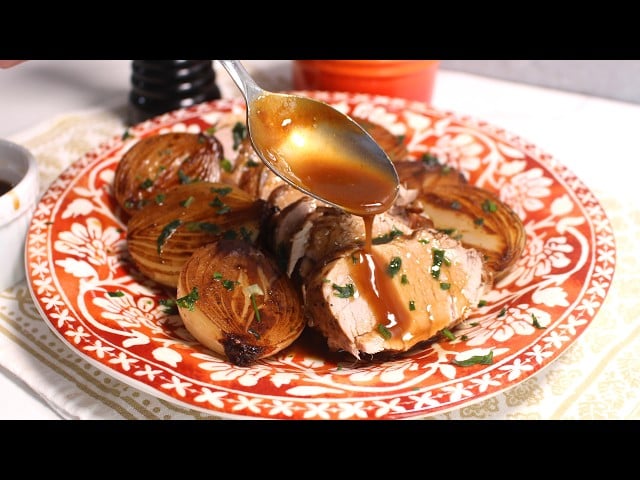
A sophisticated, restaurant-worthy dish consisting of pork tenderloin slow-cooked in a pressure cooker, served with delicious caramelized onions.
Recipe Video
Ingredients
- 1kg de Pork Tenderloin
- 1pinch de Salt
- 1pinch de Black Pepper
- 1drizzle de Oil
- 1drizzle de Olive Oil
- 4cloves de Garlic
- 4tablespoons de Soy Sauce
- 1/2enough to cover half the meat's height de Water (Hot)
- 1unit de Small Onion
- 1tablespoon de Butter
- 1teaspoon de Brown Sugar
- 3tablespoons de Balsamic VinegarSubstitui por: Shoyu
- 1/2cup de Water
- 1tablespoon de Cornstarch
- 1/4cup de Water
- Fresh Herbs (for garnish) opcional
Instructions
Season the pork tenderloin piece (approx. 1kg) all over with salt and black pepper.
Dica: Make sure to season evenly.
Heat a drizzle of oil in a pan until very hot, but not smoking, to ensure the meat sears correctly.
Dica: Do not place the meat in cold oil, as it will cook instead of sear, which can dry it out.
Sear the pieces of meat in the hot pan, leaving them undisturbed for about 3 minutes per side until well browned on the entire surface.
Dica: Avoid moving the meat right after placing it in the pan.
In a pressure cooker (or the same pan you used for searing, if applicable), add a drizzle of olive oil and sauté four cloves of garlic until lightly golden.
Dica: Be careful not to burn the garlic, as this can make the sauce taste bitter.
Add the seared meat to the pressure cooker, stir in about four tablespoons of soy sauce, and cover the piece with hot water until it reaches half the height of the meat.
Dica: Use hot water to speed up the cooking process.
Cover the pressure cooker and let the meat cook for 25 minutes, counting the time from when the pressure starts (hissing). Lower the heat after the pressure begins.
Prepare the onions: cut the small onions in half, keeping the bottom root end intact to prevent them from falling apart, and peel off the first layer of skin.
Dica: Do not remove the small 'tail' of the onion, as it helps maintain the shape during cooking.
Melt a tablespoon of butter in another pan and brown the onions cut-side down over low heat.
Season the onions with a pinch of salt, black pepper, a teaspoon of brown sugar, and three tablespoons of balsamic vinegar, adding a half cup of water.
Dica: The brown sugar adds an extra layer of caramelization.
Cook the onions over low heat for 5 to 10 minutes, stirring occasionally, until they are tender and most of the liquid has evaporated.
Dica: Check the liquid level so it doesn't stick to the bottom of the pan.
Remove the lid from the onion pan and let it simmer for about a minute to dry out the remaining liquid and intensify the surface caramelization.
Release the pressure from the meat cooker and set the meat aside on a plate, reserving the cooking liquid for the sauce.
Dica: The reserved liquid is rich in flavor and should not be discarded.
Strain the reserved meat cooking liquid into a clean saucepan to create a smooth base for the sauce.
Dica: The sautéed garlic can be discarded or served separately, as its flavor has already transferred to the liquid.
Dissolve one tablespoon of cornstarch in 1/4 cup of water and add this slurry to the simmering sauce, mixing well.
Dica: Mix the starch completely into the cold water before adding it to the boiling sauce to prevent lumps.
Cook the sauce for another 3 to 5 minutes after adding the cornstarch, stirring until it thickens slightly and achieves a velvety texture.
Dica: The sauce does not need to thicken excessively.
Slice the cooked meat into medallions; it should be extremely tender and easily shreddable.
Assemble the dish by arranging the meat medallions, topping them with the caramelized onions, and a sprinkle of fresh herbs for freshness and garnish.
Dica: Use a nice plate to enhance the presentation.
Finish the dish by drizzling everything with the prepared velvety sauce.
Did you enjoy this recipe?
Nutrition Facts
TACO Table - per serving
- Energy1605 kcal80%
- Carbohydrates41 g14%
- Protein275 g366%
- Total Fat32 g57%
- Dietary Fiber6 g24%
*Daily reference values based on a 2,000 kcal diet (ANVISA). Data calculated from the TACO Table (UNICAMP).
Cuisine Type
brasileiraRequired Equipment
Categories
You might also like



Comments
Leave a comment
Be the first to comment!