
🇧🇷 Go Han Go
@
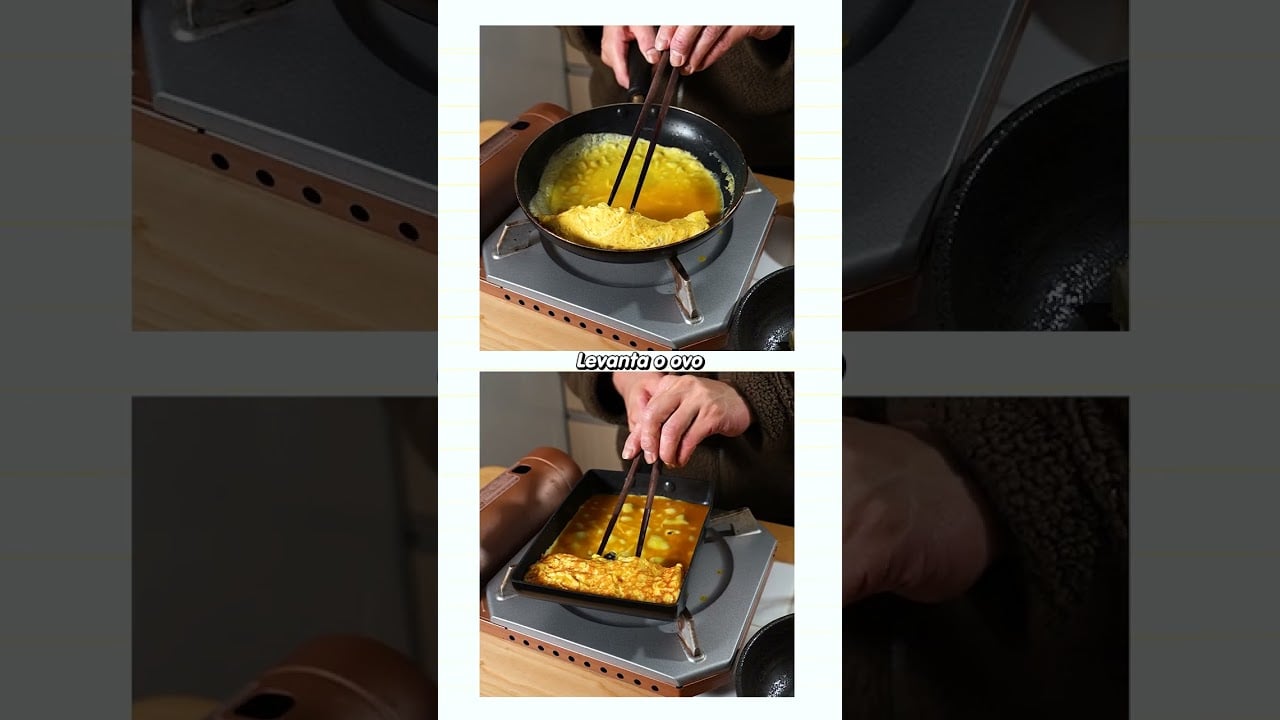
Recipe for preparing Tamagoyaki, the classic Japanese rectangular omelet, focusing on the technique of rolling the omelet in layers.
Recipe Video
Ingredients
- 3units de Egg
- to taste de Soy Sauce
- to taste de Sugar
- to taste de Mirin opcional
- 1pinch de Salt
- a little bit de Dashi stock or water
- for greasing de Oil
Instructions
Crack the eggs into a bowl and whisk vigorously until the mixture is completely smooth.
Season the mixture with soy sauce, sugar, mirin (if you desire a slight touch of sweetness), a pinch of salt, and a little dashi stock or water to ensure tenderness, mixing well after adding all ingredients.
Dica: Mirin is optional and adds a delicate sweetness.
Heat the pan (square or round) over medium heat and brush it with cooking oil using a piece of paper towel held by a utensil.
Dica: To check the correct temperature, pour a thin stream of the egg mixture; if it cooks immediately, the pan is ready.
Pour about one-third of the mixture into the hot pan, spreading it evenly.
Dica: If you fill it too much, gently move it around like a traditional omelet to distribute the batter.
As the omelet begins to set, loosen the edges with a thin utensil (spatula). Begin rolling the omelet over itself, pushing the cooked layer to the back of the pan.
Dica: Loosening the sides is crucial for a good roll.
Add more oil to the empty area of the pan, spread it around, and pour in the next third of the egg mixture, lifting the already rolled layer and allowing the raw batter to flow underneath it.
Let the new layer cook until the bottom releases from the pan, and then roll the previous layer over this new layer, repeating the process of adding oil and new batter.
Dica: Repeat this step until all the egg mixture has been used, forming a rectangular roll with several layers.
When finished, press the sides of the cooked roll to help seal it and give the Tamagoyaki a more square shape.
Dica: If cooked in a round skillet, the ends can be trimmed for a more perfect shape.
If you prefer a firmer texture, lightly brown the egg on all sides. For a fluffy and creamy texture, avoid over-browning.
Dica: The soft, slightly sweet texture is the defining characteristic of this recipe.
Did you enjoy this recipe?
Dietary Info
Allergens Present
Nutrition Facts
TACO Table - per serving
- Energy90 kcal4%
- Carbohydrates3 g1%
- Protein5 g7%
- Total Fat6 g11%
- Dietary Fiber0 g0%
*Daily reference values based on a 2,000 kcal diet (ANVISA). Data calculated from the TACO Table (UNICAMP).
Cuisine Type
japonesaRequired Equipment
You might also like






Comments
Leave a comment
Be the first to comment!